
Difference Between Large Cap, Mid Cap and Small Cap Companies: A Beginner’s Guide
One of the first concepts every investor should understand before investing in the stock market is market capitalization, commonly known as market cap. Companies listed on the stock market are broadly classified into Large Cap, Mid Cap, and Small Cap based on their market capitalization. Understanding the difference between Large Cap, Mid Cap, and Small Cap companies can help investors choose investments that match their financial goals and risk appetite.
What is Market Capitalization?
Market capitalization is the total market value of a company’s outstanding shares. It is calculated using the following formula:
Market Capitalization = Current Share Price × Total Outstanding Shares
A company’s market cap changes every day as its share price fluctuates. In India, the Securities and Exchange Board of India (SEBI) classifies companies based on market capitalization to maintain consistency across the financial industry.
What are Large Cap Companies?
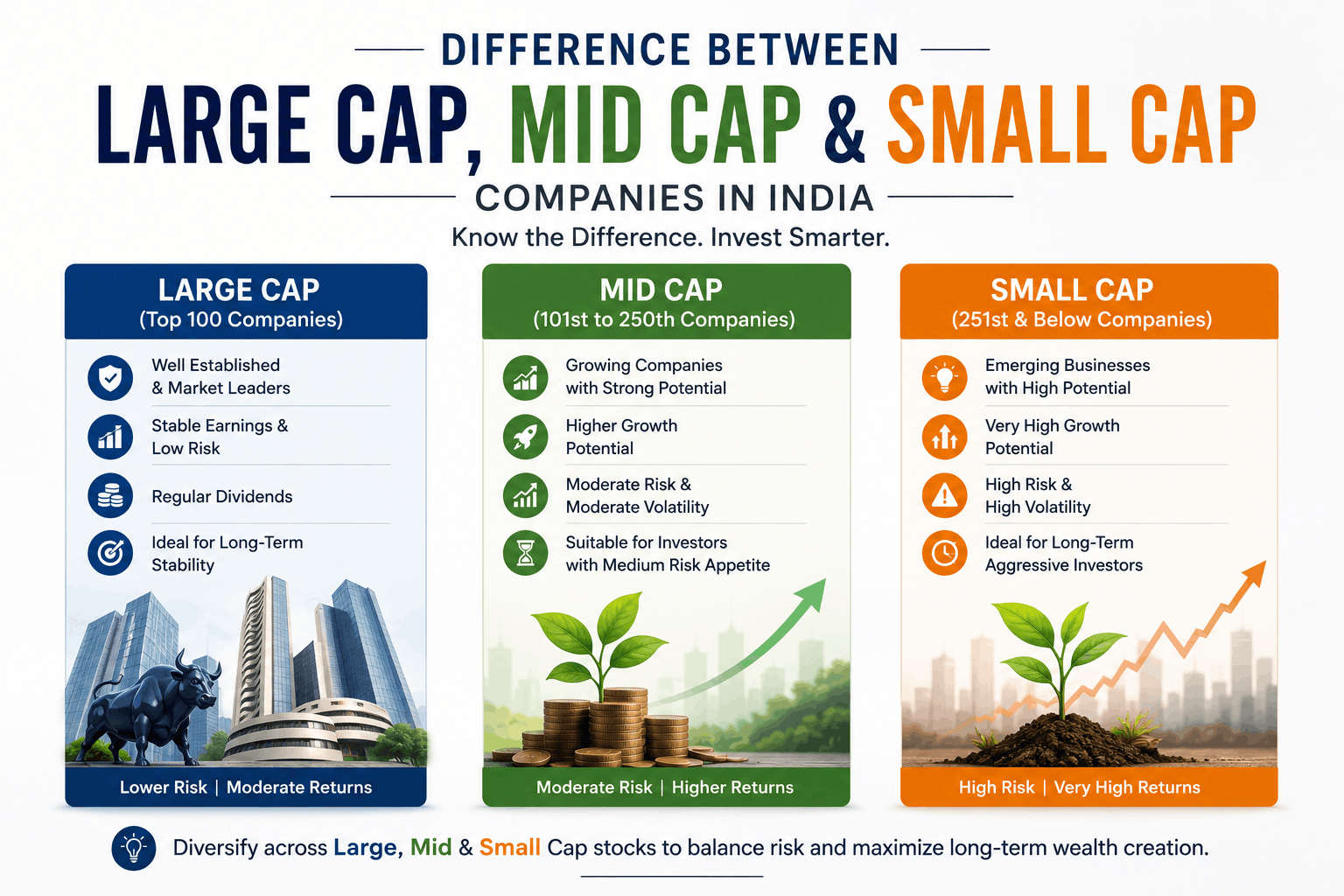
Large Cap companies are the largest and most established businesses in the stock market. These companies generally rank among the top 100 listed companies based on market capitalization.
Characteristics of Large Cap Companies
- Well-established businesses with a proven track record.
- Stable earnings and consistent financial performance.
- Lower investment risk compared to smaller companies.
- Regular dividend-paying companies.
- Strong management and brand recognition.
Large Cap stocks are often preferred by conservative investors seeking stability and steady long-term returns.
What are Mid Cap Companies?
Mid Cap companies are ranked 101st to 250th based on market capitalization. These businesses are usually in their growth phase and have the potential to become future industry leaders.
Characteristics of Mid Cap Companies
- Higher growth potential than Large Caps.
- Moderate investment risk.
- Expanding business operations.
- Better return potential over the long term.
- More volatile than Large Cap stocks.
Mid Cap stocks are suitable for investors willing to accept moderate risk in exchange for potentially higher returns.
What are Small Cap Companies?
Small Cap companies are ranked 251st and below based on market capitalization. These are relatively smaller businesses with significant growth potential but also higher investment risk.
Characteristics of Small Cap Companies
- High growth opportunities.
- Greater price volatility.
- Higher business and market risk.
- Lower liquidity compared to Large Cap stocks.
- Suitable for long-term investors with higher risk tolerance.
While Small Cap companies can generate exceptional returns, they may also experience sharp price fluctuations during market corrections.
Large Cap vs Mid Cap vs Small Cap
| Feature | Large Cap | Mid Cap | Small Cap |
|---|---|---|---|
| Company Size | Very Large | Medium | Small |
| Risk Level | Low | Moderate | High |
| Growth Potential | Moderate | High | Very High |
| Volatility | Low | Medium | High |
| Dividend Potential | High | Moderate | Low |
| Suitable For | Conservative Investors | Balanced Investors | Aggressive Investors |
Which Category Should You Invest In?
There is no single answer that suits every investor. Your investment choice depends on:
- Financial goals
- Investment horizon
- Risk tolerance
- Age
- Income stability
Many experienced investors diversify their portfolios by investing across Large Cap, Mid Cap, and Small Cap companies. This balanced approach helps manage risk while providing opportunities for long-term wealth creation.
Why Understanding Market Capitalization Matters
Knowing the difference between Large Cap, Mid Cap, and Small Cap companies helps investors build a diversified portfolio that aligns with their financial objectives. Instead of chasing short-term returns, understanding these categories allows you to make informed investment decisions based on company size, growth potential, and associated risks.
Conclusion
Understanding the difference between Large Cap, Mid Cap, and Small Cap companies is a fundamental step in becoming a smart investor. While Large Cap companies offer stability, Mid Cap companies provide balanced growth opportunities, and Small Cap companies can deliver higher returns with increased risk. A well-diversified portfolio that includes companies from different market capitalization categories can help investors achieve long-term financial success.
Disclaimer: Investments in the securities market are subject to market risks. Please read all related documents carefully before investing. The articles published on this website are for educational purposes only and do not constitute investment advice. Content is reviewed by a SEBI Registered Research Analyst (SEBI Reg. No. INH200009193) and BSE Enlistment No. 5525.