
How to Read a Balance Sheet: A Beginner’s Guide to Understanding a Company’s Financial Health
Investing in the stock market is not just about following news or market trends. Successful investors make informed decisions by analyzing a company’s financial statements, and one of the most important among them is the Balance Sheet. If you’re learning the basics of the stock market, understanding how to read a balance sheet is an essential skill that can help you identify financially strong companies and avoid risky investments.
What is a Balance Sheet?
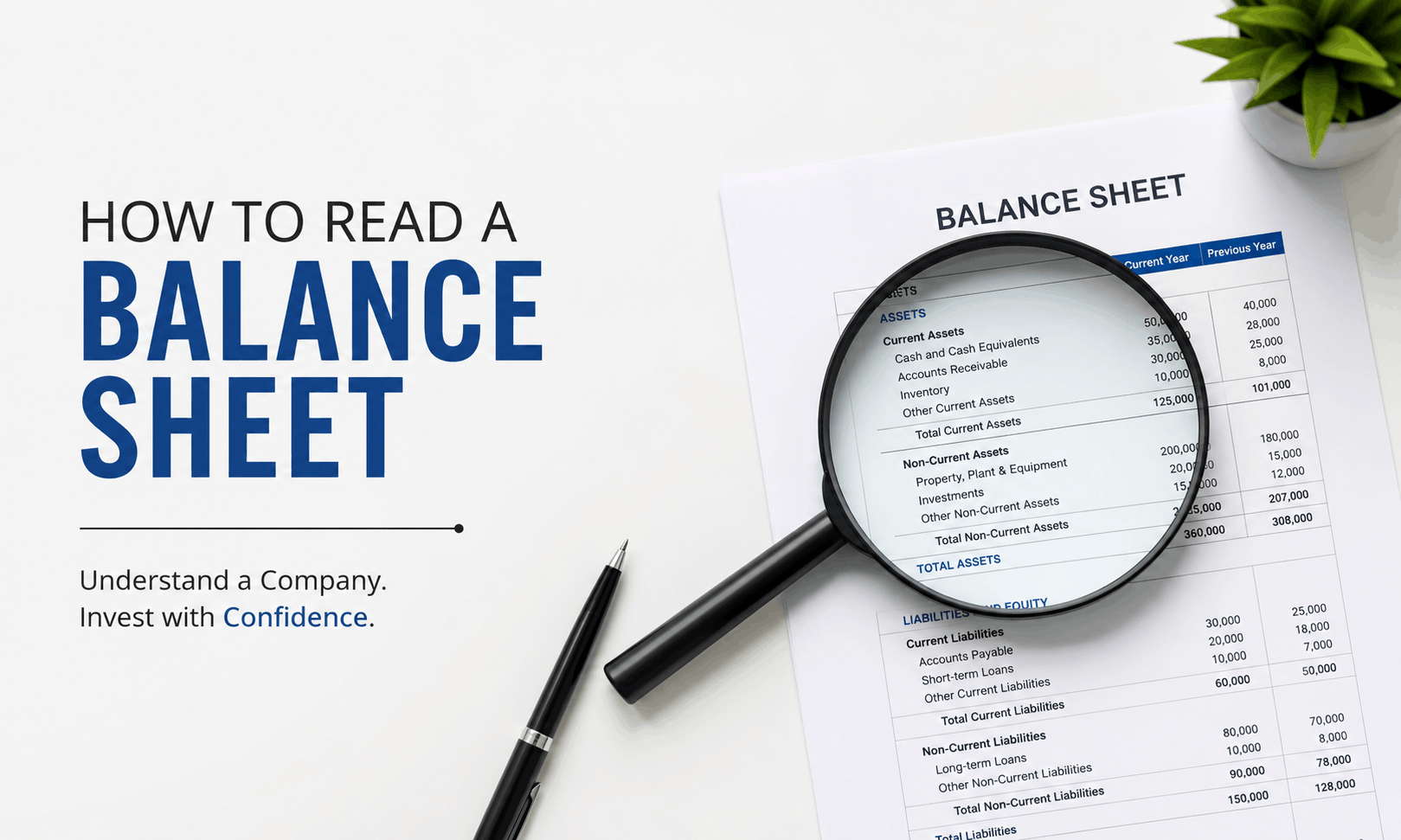
A balance sheet is a financial statement that provides a snapshot of a company’s financial position at a specific point in time. It shows what the company owns (Assets), what it owes (Liabilities), and what belongs to its shareholders (Shareholders’ Equity).
The fundamental accounting equation is:
Assets = Liabilities + Shareholders’ Equity
This equation ensures that every asset owned by the company has been financed either through debt or by shareholders’ investments.
Understanding the Three Main Sections
1. Assets
Assets represent everything the company owns that has monetary value. They are generally divided into:
- Current Assets: Cash, bank balance, inventory, receivables, and short-term investments.
- Non-Current Assets: Property, plant & machinery, equipment, patents, trademarks, and long-term investments.
A healthy company usually maintains sufficient current assets to comfortably meet its short-term obligations.
2. Liabilities
Liabilities are the financial obligations or debts of a company.
They include:
- Current Liabilities: Trade payables, short-term loans, outstanding expenses, and taxes payable.
- Long-Term Liabilities: Bank loans, debentures, bonds, and other long-term borrowings.
While debt is common in business, consistently high liabilities compared to assets may indicate financial stress.
3. Shareholders’ Equity
Shareholders’ Equity represents the owners’ claim after deducting all liabilities from total assets. It includes share capital, retained earnings, and reserves.
A company with steadily growing shareholder equity often reflects consistent profitability and disciplined financial management.
Key Things to Look for in a Balance Sheet
Before investing, pay attention to these important factors:
- Compare total assets with total liabilities.
- Check whether the company has excessive debt.
- Observe growth in shareholder equity over multiple years.
- Review cash and cash equivalents for financial stability.
- Compare current assets with current liabilities to evaluate liquidity.
- Study historical balance sheets instead of relying on a single year’s data.
These indicators provide valuable insights into a company’s financial strength and long-term sustainability.
Why Balance Sheet Analysis Matters for Investors
Balance sheet analysis plays a crucial role in fundamental analysis. It helps investors evaluate whether a business is financially stable, capable of handling economic downturns, and positioned for future growth. Strong companies generally have healthy cash reserves, manageable debt levels, and steadily increasing net worth.
However, a balance sheet should never be analyzed in isolation. Investors should also review the Profit & Loss Statement, Cash Flow Statement, business model, management quality, and industry outlook before making any investment decisions.
Conclusion
Learning how to read a balance sheet is one of the first steps toward becoming a confident and informed investor. It allows you to assess a company’s financial health rather than relying solely on market sentiment or stock price movements. Developing this habit will significantly improve your investment decision-making over the long term.
Disclaimer: Investments in the securities market are subject to market risks. Please read all related documents carefully before investing. The articles published on this website are for educational purposes only and do not constitute investment advice. Content is reviewed by a SEBI Registered Research Analyst (SEBI Reg. No. INH200009193) and BSE Enlistment No. 5525.